How fit are you when strength, power, endurance and skill are measured together?
A fast runner may struggle with a heavy barbell. A strong weightlifter may find gymnastics or a long aerobic event more difficult. XENOM attempts to bring these different abilities into one repeatable test.
LINKO visited XENOM London 2026 at Olympia London to explore how the competition works, how its Elite Performance Index turns 10 different performances into one score, and what that score could mean for an athlete’s next training cycle.

What is XENOM?

XENOM isn't a race that's over in one continuous flow. It consists of ten independent tests spread over two days, with five events each day. The organiser describes the format as “The Decathlon of Fitness™.” Athletes complete five separate events each day, with each test measuring a different part of athletic performance. XENOM Official Overview
Unlike a continuous race, XENOM alternates between competition, recovery and preparation. Athletes finish one event, recover, check their next heat and competition area, and prepare for a different physical test.
That structure makes recovery and energy management part of the experience. Athletes must perform across two days rather than maintain one pace from start to finish.
The London competition took place at Olympia London on 29–30 August 2026. The official event page describes the format as “10 Events, 3 Divisions, 2 Days, 1 Score.” XENOM London 2026
What does XENOM test?
XENOM tests maximal strength, explosive power, gymnastics, muscular endurance and aerobic capacity across 10 events.
The events are fixed rather than newly programmed for each competition. According to XENOM, athletes complete the same standardised tests at its events, allowing performances to be compared across different competitions. XENOM Official 10 Events
Schedule | Event | Primary Capability Tested |
|---|---|---|
Day 1 | 1RM Snatch | Max Strength & Weightlifting Skill |
Day 1 | Wall Walk & Rope Climb | Gymnastics Skill, Shoulder Endurance & Grip Strength |
Day 1 | 60s Max Calories Echo Bike | Anaerobic Power |
Day 1 | Barbell Cycling | Muscle Endurance & Barbell Efficiency |
Day 1 | 2km Echo Ski & 3km Run | Aerobic Endurance |
Day 2 | Toes-to-Bar, DB Hang Snatch & Muscle-Up | Gymnastics, Coordination & Unilateral Movement |
Day 2 | 5RM Rhino Pull | Max Strength |
Day 2 | Burpee, Echo Ski & Echo Bike | Mixed Cardiorespiratory Endurance |
Day 2 | Heavy Clean Ladder | Power & Weightlifting Skill |
Day 2 | HSPU, Chest-to-Bar & DB Lunge | Gymnastics, Upper Body Endurance & Lower Body Muscle Endurance |
The challenge is not simply the number of events. It is the balance between them.
A strong snatch result does not guarantee an equally strong score in gymnastics or aerobic endurance. The format is designed to show both what an athlete does well and where performance drops across different physical qualities.
Event movements, loads and standards can vary by division. Athletes should review the current official standards before training or registering. XENOM’s official 10 events
How is XENOM different from HYROX? — If HYROX is a marathon, XENOM is an Ironman.
How does XENOM differ from the currently trending HYROX? HYROX and XENOM both use standardised formats that can be repeated across locations. However, their race structures, scoring methods and physical demands are different.
Category | HYROX | XENOM |
|---|---|---|
Competition structure | A continuous race alternating eight 1 km runs with eight functional workout stations | 10 separate tests completed over two days |
Final result | Total finish time | EPI score calculated from all 10 events |
Main physical demands | Running, pacing and functional muscular endurance | Maximal strength, power, gymnastics skill and endurance |
Skill requirements | No advanced weightlifting or gymnastics movements in the standard race format | May include snatches, muscle-ups and handstand push-ups, depending on the division |
Athlete experience | Athletes move through the full course in one continuous sequence | Athletes compete, recover and prepare again between events |
Performance data | One overall completion time | Event results measured in weight, repetitions, calories or time, then converted into points. |
HYROX is a mass-participation fitness race where anyone can join without separate qualifiers, with the final ranks decided by completion time. On the other hand, XENOM offers an athlete-style competition experience, converting actual performance records from each event into scores to sum them up. HYROX 2026/27 Singles Rulebook, XENOM 2026 Rulebook
So, while "how fast did you finish?" is the first thing you see in HYROX, the athlete's results in XENOM are explained by "what score did you get across the ten capacities?". It’s not about which format is superior, but rather that the shape of achievement the participant walks away with is different.
Why are the participation numbers so different?

HYROX and XENOM currently operate at very different stages of growth and are accessible to different athlete populations. According to CNBC's Worldwide Fitness Industry Special Report 2026, HYROX has about 1.4 million annual participants.
This difference can be seen even in a single event. AirAsia HYROX Incheon, held at Songdo Convensia in Incheon from May 15 to 17, 2026, saw more than 15,000 athletes compete. Around 10,000 spectators also visited the venue. 2026 HYROX Incheon Coverage
In contrast, Hybrid Fitness Media's XENOM Season 001 Inaugural Race Analysis Report 2026 recorded about 400 participants for the first XENOM event. The published Day 1 results show 372 finishers across individual and doubles divisions. XENOM Inaugural Event Day 1 Results
Since the tracking standards differ, it is hard to directly compare these figures on equal terms. However, we can clearly see that HYROX, which has expanded its mass participation base, and XENOM, which has just kicked off its first season, are in very different stages of growth.
How does XENOM EPI scoring work?
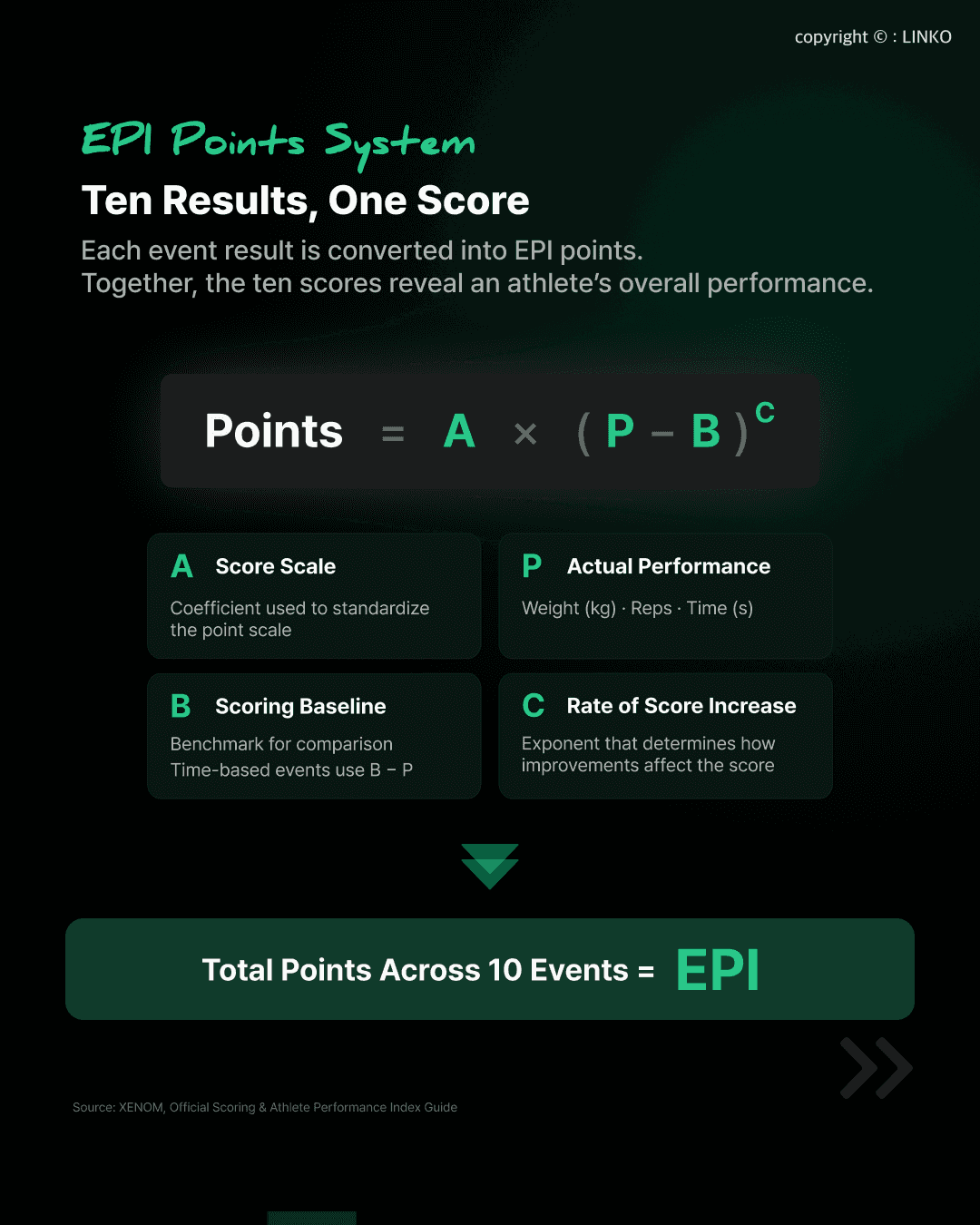
The Elite Performance Index converts different types of performance into points and combines the results into one score.
A snatch is measured in kilograms. An AMRAP is measured in repetitions. A run or ski event is measured in time. These results cannot be added together directly, so XENOM applies an event-specific scoring formula.
For load- and repetition-based events:
Points = A × (P − B)ᶜ
For time-based events, where a lower result is better:
Points = A × (B − P)ᶜ
The variables represent:
Variable | Meaning |
|---|---|
A | A coefficient that adjusts the scale of the scoring curve |
P | The athlete’s recorded weight, repetitions or time |
B | The performance threshold at which points begin |
C | An exponent that controls how quickly points increase as performance improves |
Each event uses its own parameters. The athlete’s 10 event scores are then added together to produce the final EPI.
XENOM states that its formula is based on the points model used in the Olympic decathlon. XENOM Official Scoring Guide
Is 1,000 points the maximum for each event?
No. In XENOM scoring, 1,000 points represents an elite performance benchmark rather than a maximum score.
An athlete who exceeds the benchmark can earn more than 1,000 points in that event. The official system does not set a fixed theoretical maximum.
This distinction matters because EPI is not simply a ranking score based on who competed that day. It converts an athlete’s actual output using a predefined scoring curve.
A stronger field can change an athlete’s final placing, but it does not automatically reduce the points awarded for the same recorded performance.
What can an EPI score tell an athlete?

A total EPI shows overall performance, while individual event scores reveal where that performance came from.
Two athletes can finish with similar totals but have very different profiles. One may score more heavily in strength events, while another earns more points through gymnastics and endurance.
This makes the event breakdown more useful than the total alone when planning future training.
An athlete can ask:
Which events contributed most to the total?
Where did performance fall below the athlete’s other results?
Did improving one area affect another?
Which event offers the clearest opportunity for progress?
XENOM presents progress tracking and cross-competition comparison as central uses of EPI. If the same events and scoring standards remain consistent, athletes can compare their performance across different locations and competition dates.
What did an athlete at XENOM London think of the format?

Met on-site in London, Carlos Albaladejo is an athlete from South Korea's CrossFit Marvel and a member of the CrossFit Seminar Staff. He has consistently competed in the CrossFit Open since 2012 and finished 12th in the Men's 35–39 division at the 2024 CrossFit Games. Carlos Albaladejo Official Athlete Profile
Having trained and competed in functional fitness for a long time, he explained why EPI felt different from traditional competitions:
“What I find interesting is that, regardless of who competes, the team with the most points can win.”
— Carlos Albaladejo, XENOM London 2026 Competitor
His observation highlights the distinction between performance points and placing. Final standings still depend on how an athlete’s total compares with the rest of the field, but each event score is calculated from the athlete’s recorded output.
Carlos also saw potential in the wider competition experience.
And it wasn't just the scores that caught Carlos's attention.
“I think the CrossFit market needs an event with the same kind of presence as HYROX. Being here made me wonder whether XENOM could become the HYROX of CrossFit.”
“You can tell how much thought has gone into the event production. The venue is impressive too.”
For Carlos, the difference was not limited to the scoring system. The venue, event production, warm-up, recovery periods and anticipation before the next heat all shaped the athlete experience.
Can a standardised score turn one competition into a repeatable goal?
A fixed format can make the second competition more informative than the first.
When the events and scoring standards remain consistent, an athlete can compare a later result with an earlier benchmark. That creates a possible cycle:
Compete → Review EPI → Identify weaker events → Train → Retest → Measure change
The result does not have to end at the competition venue. Athletes can practise specific movements, coaches can adjust training priorities, and the next competition can become a planned reassessment rather than a vague attempt to “do better.”
There is currently no verified public evidence showing that EPI increases repeat participation. This is LINKO’s interpretation of how a fixed competition and progress-tracking system could influence athlete behaviour.
The cycle only becomes meaningful when athletes understand their scores, can turn them into training decisions and can see whether those decisions change later results.
The athlete journey continues before and after race day
A measurable goal can shape what an athlete does long before and after the competition itself.
Before the event, athletes may need to build specific skills, plan their conditioning and strength work, choose appropriate equipment and manage recovery.
After the event, they can review their score, identify weaker areas and decide when to test themselves again.
This creates touchpoints beyond the entry ticket itself. Coaching, equipment, recovery and performance tracking can all become part of the athlete’s wider performance journey.
For gyms and fitness brands, the relevant question is not limited to exposure on competition day. It is also worth examining what athletes seek before the event and what they choose to work on after receiving their results.
XENOM’s clear identity also creates an entry barrier
XENOM offers a detailed test of athletic performance, but its demands may make it less accessible to beginners.
Movements such as snatches, muscle-ups and handstand push-ups take time to learn. Athletes must prepare for 10 events and manage two days of competition. Entry fees, travel, accommodation, training and equipment can add further demands.
The EPI formula may also be difficult to understand at first. A precise scoring model has limited value if athletes cannot see what their score means or how to use it.
XENOM’s Compete division reduces movement complexity and loading, but it does not remove every barrier. Athletes still need to understand the format and prepare for the two-day, 10-event experience.
Lowering the entry barrier therefore involves more than scaling individual movements. The competition must also explain why the test is worth attempting, what the resulting score reveals and how athletes can use it in their next training cycle.
Can XENOM's scores spark another challenge?
XENOM asks a different question from a race measured by one finish time: what kind of athlete are you across 10 separate tests?
Its defining feature is not simply the inclusion of difficult movements. It is the combination of fixed events and a repeatable scoring system that can show athletes both their strengths and their gaps.
The long-term question is whether EPI becomes a meaningful number for competitors.
If athletes can understand the score, use it to set training priorities and measure themselves again under comparable conditions, one competition could lead naturally to the next goal.
The same principle applies to gym operations.
Attendance, class participation, member communication and membership renewal data become useful when they help an operator decide what to do next.
LINKO is a group fitness management platform operated by HIVIS Inc. It supports the management of class schedules, attendance, member communication and membership data so operators can use everyday activity as a practical basis for operational decisions.
Just as XENOM sets the benchmark for the next training with scores, LinkO sets the benchmark for the next operations with data.

Frequently Asked Questions
What is XENOM?
XENOM is a functional fitness competition consisting of 10 standardised events held over two days. It tests strength, power, gymnastics, muscular endurance and aerobic capacity, then combines the event results into one Elite Performance Index score.
How is XENOM different from HYROX?
HYROX is a continuous race made up of eight 1 km runs and eight functional workout stations, with total finish time determining the result. XENOM consists of 10 separate events over two days and converts each performance into points. Depending on the division, XENOM also includes advanced weightlifting and gymnastics movements.
How does XENOM EPI scoring work?
XENOM converts the weight, repetitions, calories or time recorded in each event into points using predefined event-specific formulas. The 10 event scores are added together to create the athlete’s total Elite Performance Index.
Is 1,000 points the maximum for a XENOM event?
No. A 1,000-point performance represents an elite benchmark, not a maximum. Athletes who exceed that benchmark can earn more than 1,000 points in an event.
Can beginners compete in XENOM?
XENOM offers a Compete division with reduced movement complexity and lighter loads than higher divisions. However, participants still complete 10 tests over two days, so they should review the movement standards and assess their preparation before registering.
※ The competition structure and scoring system were written based on the official XENOM website and the 2026 Season Rulebook Version 1.5, verified on September 16, 2026. The competition format and rules are subject to change. The re-measurement structure, performance journey, and growth potential are LinkO's interpretations based on on-site interviews and public records.